Sunday, April 24, 2011

New Ad-Supported Amazon Kindle sheds new light on advertising within the publishing world

(This blog post has been edited from its original published version by the author)

For some who already have an Amazon Kindle eReader, the newest development in Amazon’s Kindle may be a bit shocking or perhaps long awaited.

The latest version of the Amazon Kindle is an ad-supported version that actually costs less!!
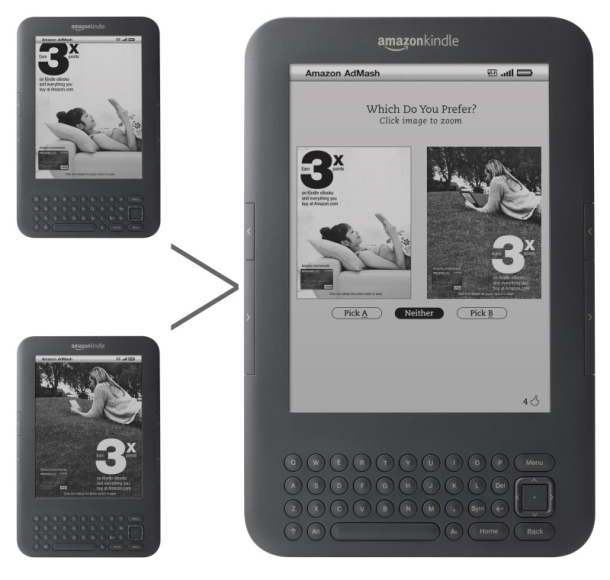
According to an April 11th article on Cnet news by David Carnoy, Amazon shipped its new ad-supported version of the popular e-reader on May 3 for just $114 (or $25 less than the standard Wi-Fi-only Kindle, which retails for $139). This new model--available for preorder now--is also Wi-Fi-only and comes in the same carbon color as its ad-free sibling. Specs-wise, the two devices are identical. 
(Credit: Amazon)
Customers now have three  different versions of the Amazon Kindle to choose from, the ad-supported version being the cheapest and latest model.

Though some customers might find the ads on their new kindle irritating or distracting, they can quickly get around the first batch of rotating screen saver ads by hitting the home button.

On the home screen of the new kindle, customers will notice a small ad running along the bottom of the screen. As of now, ads don't appear within books themselves, though some feel that's coming soon. 

According to a Dec. 13th article on the Wall Street Journal by Emily Steel, one digital-book store, Wowio Inc., is making inroads selling ads in the e-books users download from its site onto, say, laptops or e-readers like Apple's iPad and Amazon's Kindle. Some Wowio e-books have three pages with promotions: an introduction and a closing page each with an ad, plus another full-page ad. The company also is experimenting with techniques to insert ads between chapters and to target ads using profile information that users submit to its website, says Wowio Chief Executive Brian Altounian. 

As the above video from YouTube, brings up some interesting questions about the new ad-supported kindle. (Almost is more of an audio track than a video but still has some good questions in it)

But ads in e-books will most likely be tough to sell. 
According to the Dec. 13th article by Emily Steel on the Wall Street Journal, while it was typical for books a century ago to be published in serial form with ads, in-book advertising now is atypical. For starters, most books sell only a few hundred thousand copies, not enough to interest most advertisers. And many author contracts say the writer has to approve any ads. The lifespan of books, meanwhile, is such that an ad that appears when it first was published could be irrelevant years later. But digital books can address that problem by inserting ads that are appropriate for when a person accesses the book and targeted to the reader's interests. Some companies also are working to sell space across a number of books to entice marketers to purchase ads. 
Because the new ad-supported version of the Amazon Kindle seems to work well for Amazon and will most likely attract enough sponsorship and customers due to the lower price, you might be able to expect the price of the Kindle to continue to drop over the years and maybe even become free someday...

Personally, I think that the possibility of free e-readers or even free books in general would be awesome, though I am still suspicious about Amazon’s ability to delete books; but if it was free I would probably take an Amazon Kindle anyway.


Friday, April 1, 2011

The Kindle could pose a problem to your personal library but is it really hurting the publishing world?

(This blog post has been edited from its original published version by the author)
It's hard not to love Amazon's e-book reader, the Kindle; it's light, thin, and disappears in your hands. Load up a good book and you'll soon forget you're reading plastic rather than paper. You'll also wonder how you ever did without it. The Kindle makes buying, storing, and organizing your favorite books and magazines effortless. You can take your entire library with you wherever you go and switch from reading the latest New Yorker to the latest best-seller without rolling out of bed.
This is how Farhad Manjoo defined the Amazon Kindle in a Feb. 26, 2009 article on slate.com.


Photo from ebookreadersoftware blog
I have contemplated purchasing an e-reader, and have leaned toward the Kindle in particular, partially because of definitions such as Manjoo's. However, recent research has led me to rethink purchasing a Kindle based on restrictions the e-reader puts on book owners, and the publishing world in general.

A March 22nd article by

Photo from Gizmodo


In June (of 2009), fans of Ayn Rand suffered the same fate—Amazon removed Atlas Shrugged, The Fountainhead, and The Virtue of Selfishness, with an explanation that it had "recently discovered a problem" with the titles. And some customers have complained of the same experience with Harry Potter books. Amazon says the Kindle versions of all these books were illegal.
Photo from The Writing Nut
Amazon did promise to no longer delete customer's books...but I would still be a little wary because although they promised to never do it again...they still have the technical capabilities to delete user's books. Because of this capability and the always unstable nature of electronics I would say that today individuals who are moving their libraries to the digital age are at risk, at risk for loosing something usually taken for granted...the full ownership of our books, and not just books but music and video collections as well. A person can't even borrow out a book today, unless it's in hard copy format, without worrying about getting in trouble or loosing their book 'file'.

Many, like myself have seen the kindle and other e-readers as the future for books and the publishing world, but could they really be the beginning of digital book banning and media banning future run by large corporations?  And what will happen when the e-book world starts to be run by only a few corporations? Or perhaps is all this really trying to help out the publishing world by raising the market through restrictions so that more people have to buy a book rather than just sharing them? So many questions, so few answers...

Friday, March 11, 2011

The History of the Espresso Book Machine

Have you ever been frustrated when trying to buy a book only to find out that it was out of stock, out of print, or delayed in delivery? The frustrations surrounding book buying can seem endless at times. Sometimes even buying a book online becomes a hassle with shipping fees and the delivery wait, which can take longer if bad weather gets involved. However there are machines that can print you a book in an instant, eliminating the wait and hassle. One of those machines is the Espresso Book Machine.

The Espresso Book Machine was described in a 2010 OnDemandBooks.com article in the following words:
A Fully integrated patented book making machine which can automatically print, bind and trim on demand at point of sale perfect bound bookstore-quality paperback books with a full-color cover indistinguishable from their factory made versions.

Photo from dailymail.co.uk

The 'On Demand Books' website compared the Espresso Book Machine to Gutenberg's printing press invention, saying that "the Espresso Book Machine will do for the world what Gutenberg's press invention did for Europe in the 15th century."  

The Espresso Book Machine Channel on Lightingsource.com said that the Espresso Book Machine is the latest pioneering distribution in publisher-to-market pathways that will change the way books are consumed.

Aspiring novelists can even bring in a CD of their work and print out a bound copy of their own novel. (Read more about this concept at : http://www.dailymail.co.uk/sciencetech/article-1173013/A-novel-idea-The-machine-print-book-minutes.html#ixzz1GM8QzlD9)

But how did this unique machine come about?

Well, according to the On Demand Books website, it all started back in 1999 when a man by the name of Jason Epstein held a series of lectures at the New York Public Library about a vision for a new generation of pod technology, a fully automatic, low cost device that could be placed almost anywhere. Epstein was unaware that a prototype of a similar machine actually existed in the St. Louis workshop of an inventor named Jeff Marsh.

Then in 2003, Mr. Epstein and his partner Dane Neller founded the company called "On Demand Books" or ODB to develop Marsh's machine and integrate it into the digital world. A grant from the Alfred P. Sloan Foundation helped provide the funding for ODB to develop, test and later build the first beta version of the machine. This first beta machine was installed in the World Bank InfoShop located in Washington, D.C. in April of 2006. There the machine printed thousands of World Bank publications over the years.

In September of 2006, ODB installed a second beta publishing machine at the Library of Alexandria, Egypt. This machine was made to printing books in Arabic.

The first actual Espresso Book Machine, Version 1.5, was introduced during the summer of 2007, on a trial run of ninety days at the New York Public Library. Since then, the machine has been installed in multiple locations across the globe, printing multitudes of books for customers.


(Watch the above Video from YouTube to learn more about how the Espresso Book machine Works)

The new version of the Espresso Book Machine, Version 2.2, is now available and is currently being placed in various locations across the world.

So that's a little background history on the Espresso Book Machine.

I found this all very interesting and am eager to find a machine near me to buy an out of print book that has been hard to find.

The goal is to eventually get digital files for all out of print and in print books so that you could literally buy ANY book from an Espresso Book Machine or similar book vending machine.

The question is...how will this affect not only the publishing industry, but also the bookstore industry, both online and in stores??

Sunday, March 6, 2011

Electronics become more realistic: Silk-based flexible ereaders

Photo from: http://www.slashgear.com/
(This blog post has been edited from its original published version by the author)
 
I was interested to learn that Researchers at a Taiwan university recnetly claimed that they have figured out a way of using silk membranes to help create bendable or flexible electronic devices such as eReaders, LED displays and radio-frequency identificaton tools according to a March 3 article by PC World. 

Wouldn’t that be something, an electronic device that you could bend like you would a magazine or newspaper. I’d buy it just for the uniqueness of it, I mean seriously, how many computers or eReaders can you bend right now?

According to the March 3rd article from PC World :
 
The technology turns liquid silk into membranes that work as insulators for flexible thin-film transistors, a component of bendable electronics. The membranes may even improve the speed and performance of a device's transistors.

This video from YouTube explains more about flexible electronics

But, as a journalism student I see this new invention of flexible ‘silk’ technology to be intriguing. Not only will it help keep the idea of holding a traditional newspaper somewhat alive, it will also add new possibilities for, not only writers, but designers as well. Designers would no longer have to stick to straight horizontal designs, but could add curves and other creative features to their publications.

I would rather have my publication be on a flexible electronic device or flexible eReader rather than a regular eReader, at least it would still be similar to the original thing and would have more possibilities. 

According to a March 4 article on SlashGear.com, the Taiwanese researchers have already started discussions with manufacturers to start the new silk based electronics market.

All this new technology is both amazing and mind boggling to me. I just can’t imagine using silk membranes to come up with flexible technological devices. Wow! That’s all I can say about that.

However, we may be waiting for sometime until we see flexible ‘silk’ technology on our local shelves as the Slash Gear article explained:
Although silk is among the more expensive fabrics, in comparison to flexible electronics components it’s far more affordable. The research team expects the silk cost to be around $0.03 per device, and since it’s a natural fiber the ecological impact is reduced as well. No word on which manufacturers are looking to use the new fabric technology, nor when we could expect to see rollable displays and other gadgets based on it.
This isn’t the first time that academic researchers in Taiwan have come up with big technological ideas. In fact, the article on PC World explained a face-recognition vending machine, one of the world’s fastest supercomputers, and a webcam-mounted laptop antenna that scans library documents are just some of the other big Taiwanese inventions. 

I know I will be eagerly awaiting the release of these new and intriguing devices as well as watching for more amazing Taiwan inventions. Until then I will be watching for more surprising technological inventions to change the way we consume the written word…